Led and contributed on Criteo’s 4-day multiplayer virtual retreat, blending responsive 2D UI with Unreal Engine 3D gameplay, attracting 4K concurrent players and 20K+ engagement hours in four months.

In a compressed four-month timeline, I served as both design lead and hands-on contributor to concept, design, and ship an immersive, browser-based Unreal Engine experience for Criteo’s 4-day virtual retreat. Partnering with a multidisciplinary team, I balanced leadership responsibilities with direct execution—designing responsive 2D UI systems, integrating them seamlessly with Unreal Engine 3D gameplay, and ensuring functionality across desktop and mobile. One of several complex live-service experiences I delivered in parallel, this project attracted 4,000 concurrent players, generated over 20K engagement hours, and drove re-playability through mini-games and a volcanic escape room.
Overview
Role: Design Director & Lead IC (UI/UX)
Team Size: 17 (4 2D UI/UX Designers, 2 3D Artists, 3 Unreal Devs, 6 Web Devs, 2 PMs
Project Duration: 4 Months (concurrent with 3 other projects)
Players: 4,000 concurrent
Platform: Browser-based with Unreal Engine via PureWeb ‘s AWS Pixel Streaming Services – Desktop & Mobile
Results: 20K+ engagement hours, 10M points earned, 274 escape room completions

From Adobe XD Prototype to $300K Contract Win
In April, we responded to Criteo’s request-for-proposal for their annual employee retreat. Traditionally, Criteo flies hundreds of employees to a tropical island, but COVID-19 made in-person gatherings impossible. They sought a Fortnite-inspired MMORPG-style virtual island to recreate the excitement and connectivity of the physical event.
As Director of UX, I collaborated with the leadership team to align on goals, scope, and requirements. We decided that an interactive Adobe XD prototype, paired with fly-through videos of Unreal Engine environments, would best communicate our vision and win the bid.
A few weeks later, our approach paid off—we secured a $300K contract to plan, design, develop, and launch CriteoWoW Island Adventure in just four months. The win set the stage for one of our most ambitious live multiplayer experiences to date.
Strategic Planning & Hands-On Execution in a Multi-Project Pipeline
The project officially kicked-off in June. I partnered with the executive team and fellow department leads to finalize the statement of work, allocate resources, and set the production schedule. Criteo’s scope included ambitious features—player matchmaking, a self-service content portal, a 2D event platform, and a multi-day storyline. We were confident that, with the right resources, we could execute this project while concurrently delivering several other projects.
In order to meet deadlines without sacrificing quality, I hired and onboarded a senior UI/UX contractor and delegated smaller projects to junior designers. Simultaneously, I began sourcing inspiration to extend Criteo’s branding into in-game UI components to set the the overall look and feel that the senior and junior designers would propagate for cohesion across Unreal Engine 3D environments and the 2D event platform.
Delegation along with consistent documentation afforded me the bandwidth to shape creative processes and deliver production-ready asset in a complex, multi-project pipeline without missing delivery dates.


The Design that Sets the Tone
Sometimes designing the first screen is the hardest. Our earliest deliverable was the landing page for registration and building excitement. Criteo’s corporate style guide provided a strong foundation with bold colors and shape guidelines, but the real star was the event banner from their marketing partners. The senior designer and I explored how to merge the Fortnite-inspired cel-shaded style with their brand, each developing a distinct visual direction for client review.
The event banner extended Criteo’s brand in a fresh, tropical way with bold teals, oranges, and topology lines. I leaned into its vibrant palette and playful tone for the landing page, integrating subtle After Effects motion with Photoshop cutouts and pre-rendered videos. The clients loved the result, and from there I designed all core UI components before delegating the bulk of wireframing, prototyping, and asset production to my direct reports.
Nailing the first impression with a visually striking, on-brand landing page, we set the creative tone for the entire project—building early client confidence and creating a cohesive foundation for all subsequent 2D and 3D experiences.


Extending Corporate Style Guides to Playable Worlds
Pixel Canvas was a VR gaming studio first, so we approached Criteo’s project with a “how might we” mindset: How might we blend the fun spirit of video games with corporate brand guidelines? I facilitated a brainstorming session in Miro with the design and development teams, encouraging expansive, playful thinking. This was was our happy place, we were a community of gamers living our dream, creating games with purpose. We anchored on Criteo’s three brand values—Open, Together, Impactful—and used affinity mapping to ground our mini-games, storylines, characters, and quests in those values. In a nod to both cultures, each in-game character was designed by a Criteo employee.
Our convergent thinking produced a clear list of gameplay requirements, which I translated into Jira epics and stories. Jira and Confluence became essential for managing this project alongside other concurrent initiatives, allowing me to balance my responsibilities as Director with my hands-on role—refining wireframes, reviewing flows, documenting design decisions, providing design feedback, and fine-tuning in-game UI assets.
To extend the approved landing page design into the in-game UI, I drew inspiration from Sea of Thieves, Monkey Island, Fortnite, and Animal Crossing: New Horizons. I presented two visual directions—one organic and neumorphic, the other bold and cel-shaded in Criteo’s event palette. The latter was chosen for its high contrast and clear legibility, critical for our mid-30s to 50s target audience who were often unfamiliar with modern game interfaces. Every UI element was intentionally crafted for quick recognition, minimal cognitive load, and smooth onboarding, ensuring even non-gamers could navigate and enjoy the experience.


Architecting Our First Storyline-Driven, 24/7 Live Multiplayer Experience
This was our first project to feature a main storyline, quest progression, and persistent multiplayer. The virtual island was playable 24/7, encouraging employees to connect and play together with colleagues across the globe throughout the weekend. Given the short timeline and the fact that our developers had never implemented live multiplayer before, we adopted a tactical, research and development driven approach—allowing early development findings to inform our design constraints. From there, I led the creation of detailed user flows to map every interaction, identify risks, and validate solutions.
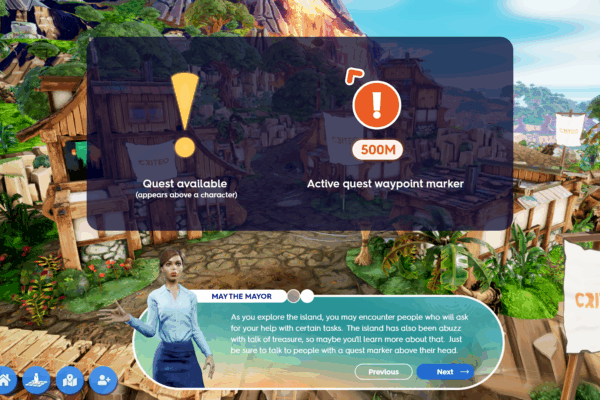
Designing for always-accessible multiplayer required rethinking game mechanics and progression systems. To strengthen social engagement, multiplayer mini-games awarded more points when played together, with total island points displayed on a leaderboard for bragging rights and converted into real-world prizes. Every multiplayer experience also included a single-player mode, each with diminishing point returns but infinite re-playability. The volcanic escape room featured a difficulty selector to feed competitive spirit and add replay value to what is typically a one-time experience.
By balancing technical constraints with player-centric design, we delivered a stable, endlessly re-playable experience that fostered connection, friendly competition, and sustained engagement—while proving our ability to execute complex live multiplayer environments across time zones.


Designing for Cohesion in a Hybrid 2D/3D Multiplayer World
Designing for a hybrid 2D/3D experience required constant context-switching between traditional web UI and game design paradigms. Over multiple Pixel Canvas projects, I learned to anticipate production challenges: in-game UI elements needed exporting much like pre-HTML5 web assets—every state as an optimized image. In addition to this, Unreal Engine’s UI alignment tools lacked the precision of Adobe or CSS. This often required extra review cycles with developers, though collaborating with those who had an artistic eye made the process far smoother.
My focus was to make the 2D and 3D spaces feel like a single, cohesive experience, even with limited resources. One approach was reusing rendered images from the 3D world as background art for the 2D video streaming page—so the beach stage in-game matched the beach backdrop in the 2D interface. Additionally, our in-browser video chat bar, Pixel Connect, reinforced this continuity by providing persistent voice and text communication between environments. Whether on the 2D site or exploring the 3D island, attendees shared the same visual cues and the same conversations reinforcing the sense of “shared presence” even when separated by technology layers lending itself to an experience that felt closer to real-world group exploration.


Balancing Controls and Camera for Multi-Platform Accessibility
As we began testing the game internally, we began uncovering improvement opportunities only playtesting can surface. Unlike modern web development, where websites and its elements can resize at will, our single game build can only change scale. There is no concept of instantly swapping buttons on the screen, or providing different controls while pixel streaming the Unreal Environment. One build meant only one UI/UX for both desktop and mobile devices.
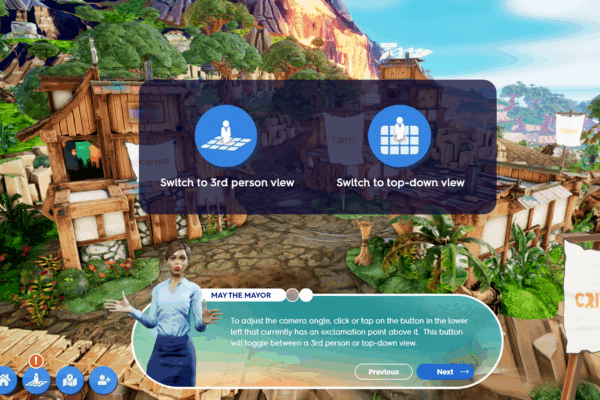
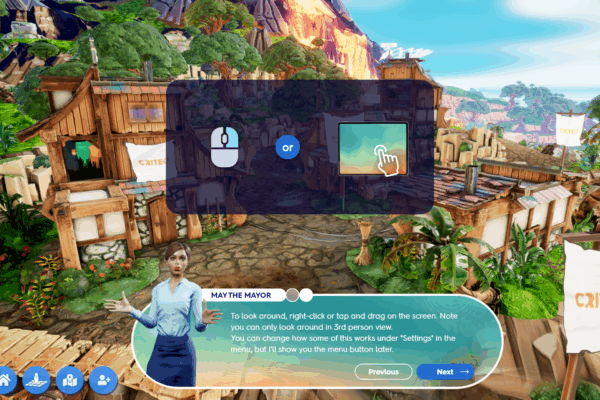
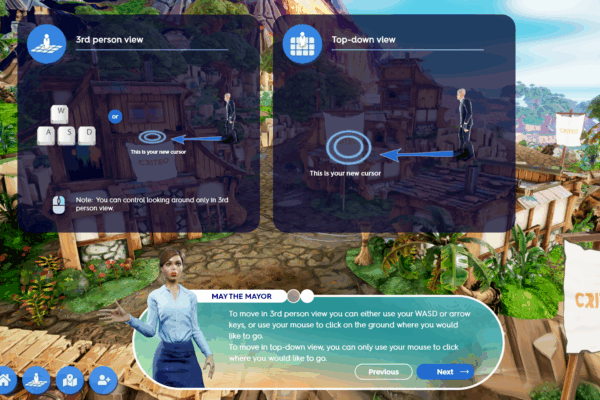
Although one UI/UX for all devices simplified some interactions, this severely affected player navigation. Originally, we offered both WASD keyboard movement and point-and-click controls, but our default third-person view restricted floor visibility. We observed that without a keyboard, mobile players would find it nearly impossible to walk in the 3D world since taps can’t be as precise as mouse clicks. To address this, we simply introduced a toggleable top-down camera button on the HUD (heads-up display). This simple addition transformed player mobility, preserving the visual depth of third-person gameplay while ensuring accessibility and fluid navigation across all platforms.


Ensuring Stability and Engagement in a Live Event Launch
In September, with just a month before launch, I shifted focus to operational readiness—training customer service representatives, participating in playtests, and establishing UI/UX quality assurance protocols. The live event ran for four days in early October, drawing 4,000 Criteo employees into 250 multiplayer island servers with active matchmaking. Players collectively earned 10 million points, completed 274 escape room challenges, and logged over 20,000 hours in livestreams and video chat.
To ensure smooth execution, leadership and I rotated 24-hour on-call shifts throughout the event, resolving issues in real time. Post-event, we extended access to the 2D video library for two weeks so attendees could revisit sessions or catch up on missed content. The result was a stable, high-engagement multiplayer experience delivered on schedule, with seamless integration between live operations, player support, and cross-platform performance.
A Milestone in Team Collaboration and Execution: Setting the Stage for the Metaverse Era
By the close of the four-day event, I was extremely proud that we completed a huge milestone. The result was our most polished, most tested, and most feature rich experience that kept 4,000+ players engaged for over 20,000 hours, reinforced Criteo’s company culture during a time of global isolation, and solidified our reputation for delivering complex, high-stakes multiplayer environments with live-service reliability. I was proud not only of the final product, but of the team’s growth and the privilege of witnessing each individual rise to the challenge.
The success of Criteo’s Adventure Island directly set the stage for our next, more ambitious project—integrating blockchain technology, metaverse capabilities, and virtual land sales into our platform just before the cryptocurrency crash in 2022.